
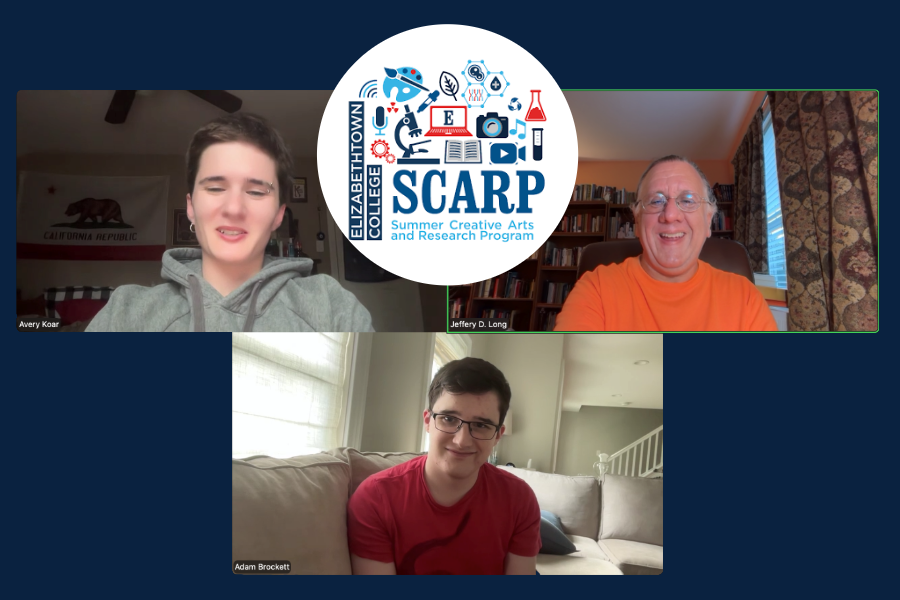
Elizabethtown College students Adam Brockett ’27 and Avery Koar ’28 are diving deeper into complex philosophical concepts and conducting thorough literary analysis of renowned philosophers as part of Etown’s Summer and Creative Arts Research Program (SCARP).
The two Blue Jays are working remotely this summer with faculty mentor and Carl W. Ziegler Professor of Religious Studies Jeff Long, examining and contrasting the concept of the Perennial Philosophy – the idea of a shared thread of experience that cuts across cultural and religious boundaries – with other philosophical concepts. Brockett is interpreting the works of various Daoist philosophers, while Koar simultaneously examines the work of Renaissance-era Italian theologians.
The work that both students are doing will contribute to a book project, “The Perennial Philosophy: The Next Draft”, which Dr. Long is writing with assistance from a grant from PRISM, the Program in the Study of Mysticism, based at Tampere University in Finland and funded by the John Templeton Foundation.
Title of Research:
The Perennial Philosophy- The Next Draft
Student Researchers
Adam Brockett ’27 (Integrative Studies- Religious and Asian Studies)
Avery Koar ’28 (Asian Studies)
Faculty Mentor
Jeffery Long, Carl W. Zeigler Professor of Religious Studies
What are you researching?
Brockett: My research can be divided into four parts: First, I’m researching the philosophies of Plato, reading his texts and analyses of them. Second, I’ll be reading various translations of major Daoist thinkers such as Lao Tzu, Chuang Tzu, and others. Once I’ve gathered information, I’ll be comparing the two schools of thought. Ultimately, I’ll be determining how both can tie into the Perennial Philosophy as outlined by Aldous Huxley, as well as how they might not.
Koar: I will be covering the topics of Prisca theologia, which means “ancient theology” in Latin, a concept developed during the Renaissance period by Marsilio Ficino, and how it relates to and differs from Perennial Philosophy. Both terms, on the surface, have the same meaning, but as you dig deeper into the concepts, you find they come from different backgrounds and use different arguments to justify the existence of underlying beliefs.
Why did you choose this topic?
Brockett: I have an immense interest in both Plato and Daoism, and having read both in the past, I noticed some similarities that I wanted to explore.
Koar: While the topic of Perennial Philosophy was not chosen by me, the idea to research Prisca Theologia was an idea from my older brother. During winter break, I had mentioned to him that I would be part of this research project revolving around the Perennial Philosophy, at which time he asked if I had ever heard of the term Prsica Theologia. After returning to campus and sitting in class with Dr. Long, I asked him if he knew what Prisca Theologia was, and from there, it was decided that it would be my topic.
What is the most interesting aspect of this research?
Brockett: The work I have done comparing the two schools of philosophy is the most interesting aspect of this research. Seeing what similarities they have is incredibly fascinating to me.
Koar: The most interesting part of this research project is the skills that I am developing and will take with me in the future. The ability to develop research questions, perform a literature search, and add to the body of research is exciting to me!
What are you hoping to accomplish through this research project?
Brockett: The goal is to eventually get this information out to the wider world in some form. Dr. Long has suggested a podcast or a YouTube series as possible methods. For this summer, the goal is primarily just about gathering research for that future project.
Koar: Throughout this research project, I aim to gain new insights into a topic I once knew little about, while also developing new and useful research skills for the future.
Talk about working with your mentor. How have they helped you throughout this experience?
Brockett: Dr. Long has been a big help in making it possible for me to do this in the first place, given that he was the one who invited me to help with his research.
Now that said research is beginning in earnest, I will likely be going to him for help in the form of proofreading what I have found or challenging ideas I have. At the end of the day, what we’re working on is philosophy, so there isn’t much assistance needed in physical tasks. However, having someone versed in these topics is very useful, since they can validate – or invalidate, in some cases, since this is philosophy – the conclusions I reach.
Koar: Dr. Long is just amazing. From my first class with him, I could see the passion he had for the topics he taught. From day one, he always provided me with insightful information both in and out of the classroom. I can tell that he not only cares deeply about his work and what he teaches, but also about the students involved. I was hesitant to accept this research offer because it would have been a completely new environment for me, but I knew that if Dr. Long were my mentor throughout the process, I would be just fine, because I knew he would never let me fail.
Hear from the faculty mentor- Dr. Jeffery Long
Avery and Adam are great students, and they work well with one another. They both have many strengths, but I especially want to mention their intellectual curiosity and interest in the kind of project we are doing together. They both have an aptitude for studying premodern texts and grasping their meaning. They’re working with figures like Plato, Lao Tzu, Chuang Tzu, Plotinus, and Italian Renaissance philosophers like Marsilio Ficino and Giovanni Pico della Mirandola and finding shared themes that unite the work of all these diverse thinkers.
