
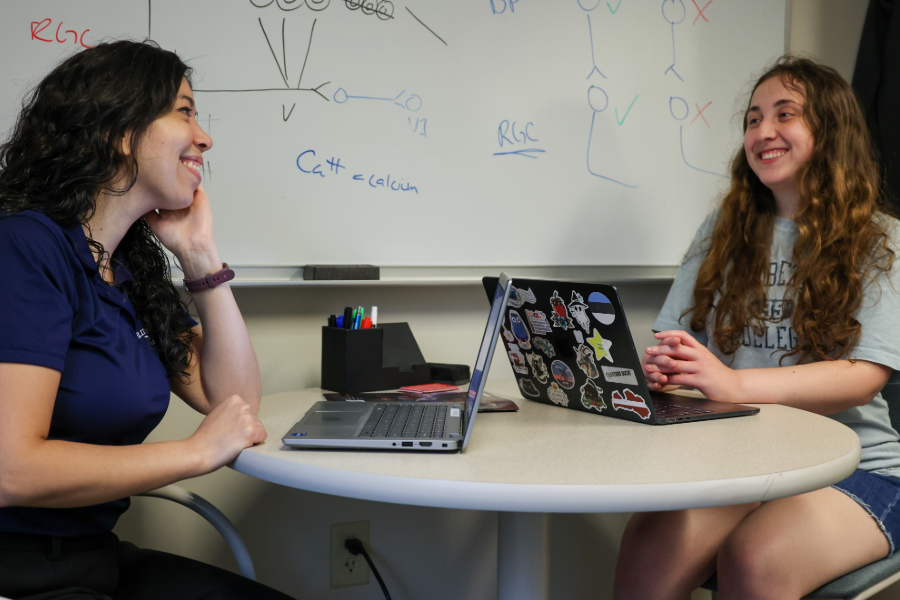
As part of Elizabethtown College’s Summer and Creative Arts Research Program, Neuroscience student Megan Spiegelberg ’27 is examining the linguistic development of individuals with a rare genetic disorder.
Spiegelberg is working closely with Assistant Professor of Psychology and Neuroscience Director Jennifer Wittmeyer and one of her frequent collaborators, the Project 8p Foundation, to research the linguistic abilities of individuals with chromosome 8p rearrangements. Spiegelberg is examining MRI data provided by the foundation to contribute to broader conversations about potential resources and support for individuals with this disorder.
Title of Research
Linking Language Development to Brain Structure in Children with Chromosome 8p Rearrangements
Student Researcher
Megan Spiegelberg ’27 (Neuroscience)
Faculty Mentor
Jennifer Wittmeyer, Assistant Professor of Psychology and Neuroscience Director
 What are you researching?
Spiegelberg: I am looking for a connection between the size of certain brain regions in 8p heroes and their level of development in their ability to produce language. 8p heroes are individuals with 8p inverted duplication/deletion syndrome, a very rare genetic disorder that can have a variety of phenotypic manifestations. I am using structural MRI data as well as other measures of linguistic development for my study. The Project 8p Foundation, a nonprofit with which Dr. Wittmeyer has been collaborating for some time, has provided us with this data.
Why did you choose this topic?
Spiegelberg: I am interested in how our developing brains gradually learn how to process sounds as meaningful language, and how to produce language of their own.
What is the most interesting aspect of this research?
Spiegelberg: Discovering how the physical structure of our brains relates to intangible behavior is the most interesting part of my research. I am so grateful for the opportunity to contribute to our understanding of the inner workings of the most complex organ of the human body, and I am especially grateful to the individuals whose data I have been working with.
What are you hoping to accomplish through this research project?
Spiegelberg: I am hoping that my results bring us a step closer to understanding the ways that chromosome 8p rearrangements can affect the development of the brain. When more is discovered about 8p syndrome, it can pave the road towards better support systems for these individuals in the future.
Talk about working with your mentor. How have they helped you throughout this experience?
Spiegelberg: Working with Dr. Wittmeyer has been great. She has provided me with the data and the tools that I need, as well as the knowledge of how to use them. Not only has she been dedicated to this project, but she has also made efforts to learn more about me as a person.
Hear from the faculty mentor- Dr. Jennifer Wittmeyer
“Working with Megan has been a wonderful experience. She is naturally curious and genuinely excited to learn, which makes her a joy to mentor. Throughout the summer, she’s shown a real commitment to understanding the relationships between language and the brain in this understudied population. It’s been incredibly rewarding to watch her confidence grow alongside her understanding of the scientific concepts, and she’s consistently asked thoughtful questions that have deepened both her own learning and our discussions as a research team.”
