
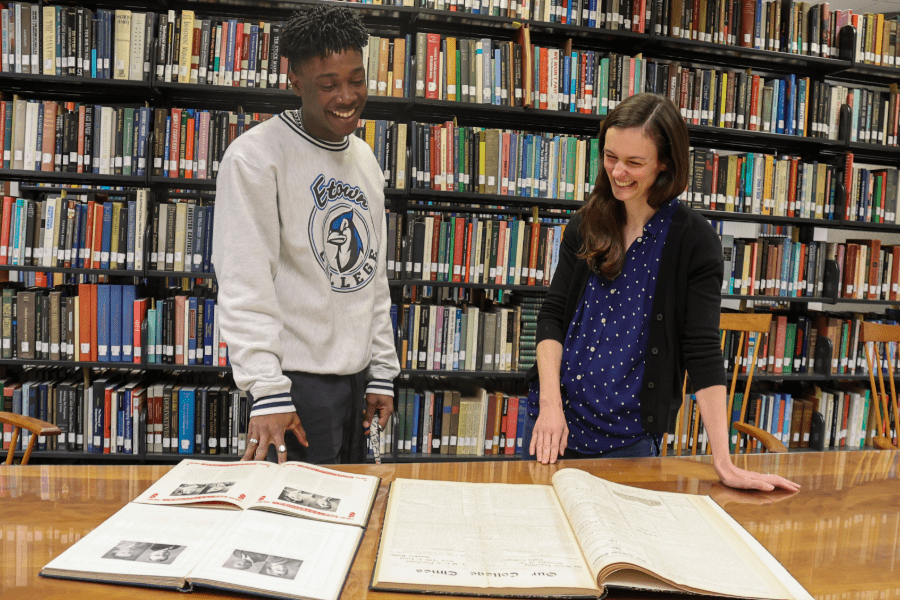
Legal Studies major Kalen Tendo ’27 is collecting and sharing the stories of students, alumni, faculty, and staff of color as part of Elizabethtown College’s Summer Creative Arts and Research Program (SCARP).
Working closely with Etown Archivist Rachel Grove Rohrbaugh, Tendo is conducting interviews to uncover personal stories about what it was like to be a person of color at Elizabethtown in the past. This research is the continuation of prior SCARP research, with the goal of helping the College better understand and preserve its history for future generations.
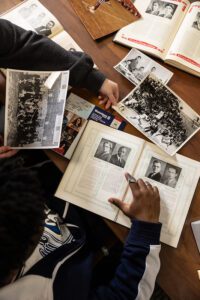
Title of Research
The History of People of Color at Elizabethtown College
Student Researcher
Kalen Tendo ’27 (Legal Studies major)
Staff Mentor
Rachel Grove Rohrbaugh, Archivist
What are you researching?
Tendo: I am continuing a project that I worked on last summer and continued throughout my school year. Essentially, I am interviewing past alumni of color. The purpose is to provide representation of their stories, rather than it being simply word of mouth, and allowing it to be more from word of mouth to the world as each of these stories deserves its own instance for recognition, appreciation, and validation. At the moment, I am interviewing alumni, faculty, staff, and past students of Elizabethtown College who have stories to contribute to the history of the school. The purpose of this round of research is to reach the corners that my research could not. Within my research, I uncovered many stories, but each one filtered to an extent. So with this new direction of the project, I am now able to uncover deeper bits and pieces of stories that only had one narrative.
Why did you choose this topic?
Tendo: I chose this topic because Elizabethtown College has made a commitment to addressing and correcting the wrongs of its past. The school is in a space of growth, but true growth requires a deep and honest reflection on history—understanding what went wrong, what went right, and how those experiences have shaped the present. As a student of color, I’m particularly interested in learning how other people of color at Etown faced adversity, and what that adversity looked like during their time here. The College is often described as having come a long way, but I wanted to understand: a long way from what? What exactly has Elizabethtown College evolved from? This research and these interviews offer perspectives that help me—and the College community—gain a broader understanding of our shared history and how much has truly changed.
What is the most interesting aspect of this research?
Tendo: The tears. The pain. The stories I’ve heard are not always about people living out a movie-like college experience. Sometimes, their stories are heartbreaking. They speak about feeling alone, unsupported, and unseen. While some are aware of these difficulties, witnessing people relive their trauma and pain firsthand has been deeply moving. As these people tell their stories, you essentially watch them relive their college experience. You see their stories play in their eyes, as their words frame subtitles for the scenes that are being displayed in their pupils. It can be difficult to hear, but the fact that they are choosing to tell their stories—and that these stories are being recorded—means others will have the opportunity to understand what they went through. It gives Elizabethtown College a chance to truly listen, learn, and do better.
What are you hoping to accomplish through this research project?
Tendo: This topic specifically contributes to helping the school gather a fuller viewpoint of issues that arose on campus. I believe it’s important to pay homage to those who went through it before I came to the school—to talk about the struggles they went through and pay respects to their triumphant victories and their tragic stories. This topic was chosen to be able to give more power to past students’ voices to be able to record and write down their experiences, as these stories can help future students of Elizabethtown College.
Talk about working with your mentor. How have they helped you throughout this experience?
Tendo: Rachel has been incredibly supportive by giving me the freedom to take the project in the direction I wanted. She allowed me to guide the interviews, encouraging me to ask the questions that intrigued me and explore areas I found meaningful. I truly appreciate that she took on a supportive role rather than trying to take full control of the project. Rachel has contributed a great deal—she makes cold calls, finds information for me to read, and consistently helps move the project forward. Overall, she has provided unwavering support, and I’m genuinely grateful to be working with her.
Hear from the faculty mentor – Rachel Grove Rohrbaugh
“While I regularly work with students in the Hess Archives, SCARP allows me the opportunity to go more in depth with them on a project. This is my second summer working with Kalen, and I love seeing the growth in his interviewing skills and all of the expertise he has gained on this topic.”
