
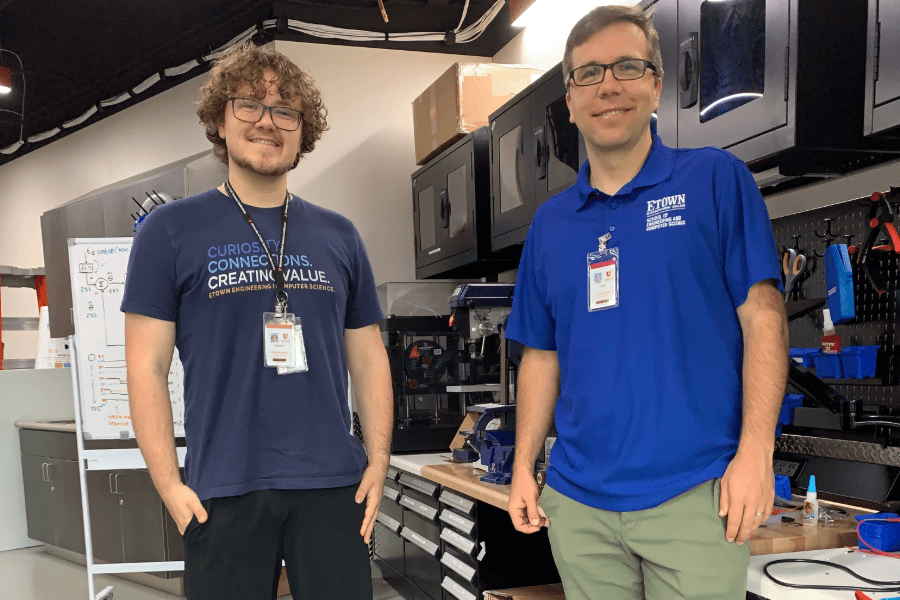
Biomedical Engineering Major Hunter Taggart ’27 is researching how electrical stimulation of the wrist can create natural hand sensations for virtual reality and prosthetic rehabilitation as part of Elizabethtown College’s Summer Creative Arts and Research Program (SCARP).
Working alongside Assistant Professor of Engineering Mark Brinton, Taggart is researching how variations in electrical stimulation, strength, speed, and frequency affect hand sensation at the University of Utah’s Craig H. Nielsen Rehabilitation Hospital. Their research focuses on applications for both VR users and amputees using prosthetic hands. Taggart is also studying how wrist positioning impacts perceived touch, with the goal of advancing more natural-feeling technology.
Title of Research
Electrical Stimulation of Nerves in the Wrist for VR and Rehabilitation Applications
Student Researcher
Hunter Taggart ’27 (Biomedical Engineering major)
Faculty Mentor
Mark Brinton, Assistant Professor of Engineering
What are you researching?
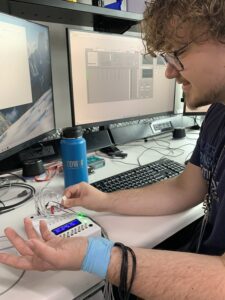
Taggart: To create natural sensations in the hand from wrist stimulation. For VR, that would look like grabbing an object in VR and feeling it in your hand. But on the rehabilitation side, that looks like amputees being able to feel what they are grabbing with their prosthetic. I am doing this by testing on myself and others, as well as seeing how the sensation in my hand changes when the amplitude, pulse width, and frequency of the stimulation are changed on my median and ulnar nerves.
Why did you choose this topic?
Taggart: I aspire to pursue a career in prosthetics after graduation. When my professor reached out about a summer research opportunity, I was thrilled to gain experience in the field I want to be a part of.
What is the most interesting aspect of this research?
Taggart: The most interesting aspect of this research has to be the applications of it. Being able to see how my project will be able to help people’s lives is an amazing thing and it helps motivate me to work harder.
What are you hoping to accomplish through this research project?
Taggart: One of the big accomplishments I am hoping to achieve is being able to get some new natural sensation through stimulation. Another one is being able to understand how the angle of the wrist changes how the stimulation feels in the hand, and being able to correct for that in future applications
Talk about working with your mentor. How have they helped you throughout this experience?
Taggart: My mentors have helped me immensely in this process; they have helped me get acclimated to Utah while also showing me how to act in a lab setting. Dr. Brinton has been amazing, as he is extremely well informed on current prosthetic technologies, and he is experienced in conducting research in this field. The graduate students I am working with have been great as well; they can answer all of the questions that I come up with and have helped me find my own projects and methods of recording data.
Hear from the faculty mentor – Mark Brinton
“I came to Elizabethtown College to work with students and help them develop an engineering mindset. It’s meaningful to see them become engaged in projects that have real-world impact, and I enjoy watching them take on research challenges and grow confident while solving difficult problems. Mentoring research is also a fun way to get to know students better and to support their growth as they explore new ideas and technologies. This summer has been particularly exciting. Thanks to recent funding, I’ve had the opportunity to bring three of my undergraduate students to Utah, where we’re conducting research with Dr. Jacob George in the NeuroRobotics Lab at the Craig H. Neilsen Rehabilitation Hospital on the University of Utah campus. Collaborating with Dr. George’s team at a major research university is both an honor and an amazing learning experience for all of us.”
