
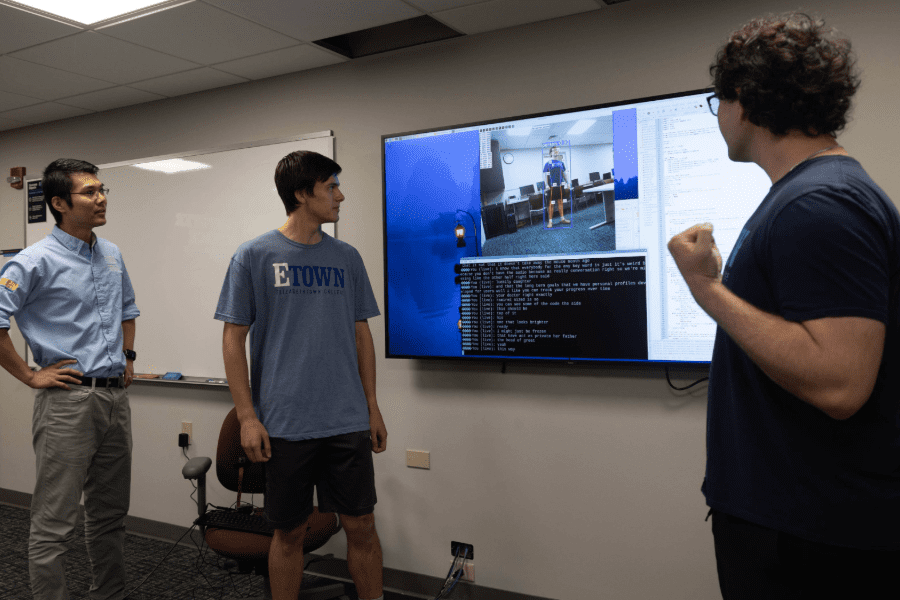
Can artificial intelligence (AI) improve senior wellness? Computer Science majors Alexander Roop ’26 and Aaron Frist ’28 are working to develop a personalized exercise coach for elderly communities as part of Elizabethtown College’s Summer Creative Arts and Research Program (SCARP).
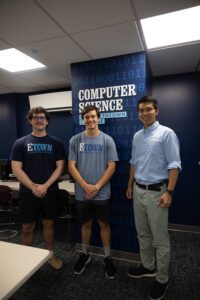
Working closely with Associate Professor of Computer Science Peilong Li this summer, the two Blue Jays are designing a fully self-contained system that uses real-time pose detection, conversational AI, and interactive features to encourage safe and engaging physical activity.
Title of Research
ARISE – An AI-powered Real-time Interactive Support for Exercise in Elderly Communities
Student Researchers
Alexander Roop ’26 (Computer Science) and Aaron Frist ’28 (Computer Science)
Faculty Mentor
Peilong Li, Associate Professor of Computer Science
What are you researching?
Roop: Our project focuses on deploying real-time, locally hosted machine learning models to promote physical activity and exercise, particularly within communities such as the elderly. We aim to support individuals who want to improve their physical health by helping them learn about different exercises and understand how to perform them correctly. This will be achieved through pose detection and the tracking of key body points and angles, enabling live form correction as users perform exercises. All models and programs will be designed to run entirely on a Raspberry Pi, which will be connected to a screen device such as a monitor or television. Once the system is running, users will have access to an intuitive dashboard where they can view their progress, engage in real-time conversation with a conversational AI assistant, start or learn more about an exercise, and play an exercise-based game. By integrating these features, our goal is to empower individuals, especially those who may be hesitant to begin their fitness journey due to fear of injury, failure, or a general lack of guidance, by providing them with a personalized and approachable fitness AI assistant.
Why did you choose this topic?
Roop: I’ve always been passionate about exercise and fitness, and I understand firsthand how powerful it can be, not just for physical health, but for mental well-being too. At the same time, I know how overwhelming it can feel to get started. Many people don’t know where to begin, what exercises to do, or how to target the areas they want to improve. I believe this initial confusion causes a lot of people to give up before they’ve even truly started their fitness journey. I chose this project because I see the potential for AI and machine learning to make that first step easier and more accessible. With the right tools, we can help people overcome that learning curve without needing to spend hundreds of dollars on a personal trainer every time they want to exercise.
Frist: I chose this topic because I am very interested in the workings of artificial intelligence and its possibilities when it comes to real-world applications. Being able to work with AI and integrate it into a product that is capable of helping people seems like a great way to get myself more familiar with my intended field and learn how AI functions.
What is the most interesting aspect of this research?
Roop: The most interesting part of this project for me has been implementing the conversational AI and watching the environment slowly come together. Since our goal is to make the AI interaction entirely audio-based, where the user speaks into a microphone and the AI responds out loud, this process has to be broken down into three core components. First, there’s the speech-to-text system, which uses a neural network to convert real-time audio into written text. That text is then passed into a large language model (LLM) to generate an appropriate response. Finally, the output from the LLM is sent to a text-to-speech model to convert it back into audio for the user. Working with these different AI components and getting them to interact smoothly has been a rewarding challenge. It’s involved a lot of trial and error to optimize the system for low latency and to make the conversation feel as natural and seamless as possible.
Frist: The most interesting aspect of my research has been uncovering the capabilities and performance levels of different AI models. We have been searching for and using very recent versions of AI models published, so with that comes observing the different ways AI companies are approaching the development of their software and models. It is amazing to see in real-time the changes and accomplishments that are made, and watching the abilities of AI grow is such an exciting reason to dive deeper into exploring its possibilities.
What are you hoping to accomplish through this research project?
Roop: Ideally, we aim to produce a final paper that documents the development process of our project and explores the practical implications of running real-time, locally hosted AI and machine learning models. This paper will not only cover the technical challenges and solutions we encountered, such as optimizing latency, model performance, and system integration, but will also reflect on the broader feasibility of deploying such systems on low-power devices like the Raspberry Pi. We plan to examine the underlying concepts of real-time model inference and detection, and how these can be applied beyond our current focus on exercise and physical health. Our goal is to demonstrate the potential of localized AI systems in a variety of real-world use cases, particularly in underserved or resource-limited communities. In addition to the paper, we plan to deliver a minimally viable product that can be tested and evaluated in different community settings to gather feedback, assess usability, and refine the system based on real-world needs.
Frist: I am hoping to become more educated about AI through this project as well as enhance my skills working with hardware. We have already run into many hurdles involving getting technology to work with other technology, and I want to continue learning what goes into fixing these problems. The experience I take from this project will give me a big step up in deeply understanding my coursework and applying it to future jobs.
Talk about working with your mentor. How have they helped you throughout this experience?
Roop: Dr. Li has been an exceptional advisor throughout this project, providing both guidance and the freedom to explore our own ideas and implementations. In the beginning, the final goal of the project felt overwhelming and almost impossible to tackle. However, thanks to Dr. Li’s structured research plan, we’ve consistently had a clear understanding of our weekly goals and the time and effort required to meet them. His support has helped break down a complex problem into manageable steps. In addition, Dr. Li has shared valuable resources and up-to-date projects for us to explore independently, many of which have directly influenced and enhanced our work. His consistent guidance, encouragement, and deep expertise in the field have made a major impact, transforming what once felt unattainable into a project we now feel confident pursuing.
Frist: My mentor, Dr. Li, has been incredibly helpful with this entire learning process. He has shown confidence in my abilities while also providing help whenever needed or requested. He has always made the experience enjoyable for me and provided insight into the new topics that I have started working with as a result of this project.
Hear from the faculty mentor – Peilong Li
“I’m involved with SCARP because I see it as the essential bridge that connects my hands-on teaching philosophy with real-world application. It’s where theoretical knowledge becomes tangible innovation. For me, the most rewarding aspect is seeing the direct results of this intensive experience. I’ve watched my students transform their SCARP projects into published papers, compelling graduate school applications, and key talking points that land them positions at top companies. Knowing I played a part in that transition from student to professional is why I’m so committed to the program.”
