
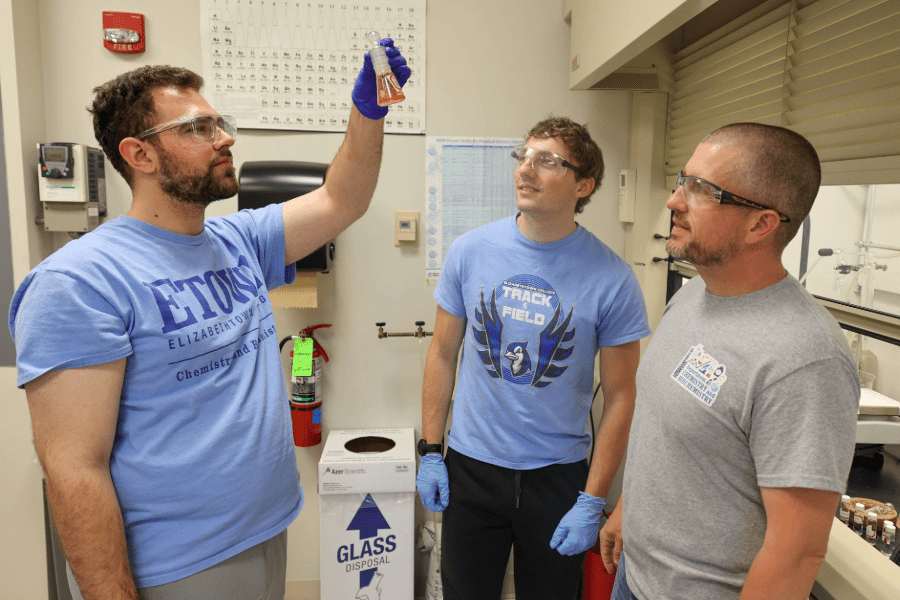
Chemistry majors Matthew Lamb ’26 and Robert Lynch ’27 are exploring how hybrid luminescent materials can detect different ions as part of Elizabethtown College’s Summer Creative Arts and Research Program (SCARP).
Working alongside Professor of Chemistry, Department Chair, and faculty mentor Dr. Jeff Rood, the students are building special structures called metal-organic frameworks (MOFs) that can hold glowing metals like Osmium and Zirconium. Their goal is to create new ways to sense certain molecules or changes in the environment.
Title of Research
Hybrid Luminescent MOFs: Bridging Metal Complexes and Porous Solids as Routes to Potential Sensor Applications
Student Researchers
Matthew Lamb ’26 and Robert Lynch ’27 (Chemistry)
Faculty Mentor
Dr. Jeffrey Rood, Professor of Chemistry, Department Chair
What are you researching?
Lamb: Starting with a Zirconium-based metal complex, an additional ligand will be put on the metal center, allowing it to link into an MOF (metal-organic framework). This doped MOF can then be used for various sensing applications of different molecules by observing its luminescence.
Lynch: Metal-Organic Frameworks (MOFs) are a system of metal centers that coordinate with organic ligands to form extended porous structures that allow for the MOF to have high stability and a large surface area. These properties allow MOFs to be used for applications such as storage and catalysis. MOFs can also be modified, allowing chemists to incorporate various metal complexes into the MOF. In my research, an Osmium (II) complex known to luminescence is synthesized and then incorporated within a Zirconium MOF, so that the luminescence of the Osmium (II) complex can be measured within the Zirconium MOF when the MOF is in the presence of different ions.
Why did you choose this topic?
Lamb: Learning about different synthetic methods and metal complex characteristics in CH242 and CH402 inspired me to pursue those aspects of the field further and see how they could be applied. Inorganic chemistry has always been something that interested me.
Lynch: I chose this topic because I enjoy being able to synthesize and experiment on compounds that have not been researched deeply, because it allows for an experience where my professor and I have to think of what methods will allow for a successful synthesis.
What is the most interesting aspect of this research?
Lamb: This research is a first at Etown. While the core of the project has stayed the same, looking at a Zirconium metal center rather than the ones other students have looked at in previous years yields very different results. Understanding those differences and designing experiments around them is definitely the most interesting.
Lynch: MOFs are also something that is a new concept for me, so being able to have a hands-on way of learning something new is always exciting for me. Additionally, gaining the ability to experience what it is like to do research and experiments that are not pre-written for a lab period allows me to prepare for what doing chemistry in the industry will feel like.
What are you hoping to accomplish through this research project?
Lamb: I’m hoping to develop my laboratory skills and problem-solving methods in new ways through this research. Also, I plan to attend graduate school, so I believe this research experience will provide a valuable first step into my postgraduate endeavors.
Lynch: I’m hoping to be able to come up with different and more efficient methods of synthesizing the different Osmium (II) Complexes and MOFs than what has been previously done. I also hope to be able to test out the luminescence of Osmium (II) complexes in a Zirconium MOF in different ions, in addition to the ions that have been previously tested.
Talk about working with your mentor. How have they helped you throughout this experience?
Lamb: Dr. Rood has been extremely helpful throughout this process. He guides my research path but allows me to take certain experiments in my own direction to answer questions. He is supportive in terms of showing me a new lab skill and is always willing to help me understand the results I obtain from different instruments. He creates a great working environment, and it’s been great to work with him.
Lynch: Dr. Rood has allowed me to experience a more hands-on way of learning in a hands-off way. Being able to plan out what needs to be done and how it needs to be done on my own has allowed me to gain more confidence on the lab bench. Though I am conducting the synthesis and lab work on my own, when there is a time I need to learn a new instrument or lab technique to help with progression in the project, Dr. Rood has been able to clearly walk me through what needs to be done and how.
Hear from the faculty mentor – Dr. Jeffrey Rood
“SCARP is a great time to have students focus on the research process. From learning how to find information in the literature, to designing and carrying out experiments, and interpreting the results, the summer provides an uninterrupted time to spend learning about the project. I find that students tend to make good progress, and it often sets them up for continuing meaningful work when they return to campus in the fall semester. It is also a great opportunity to build community within the department and the broader campus.”
