
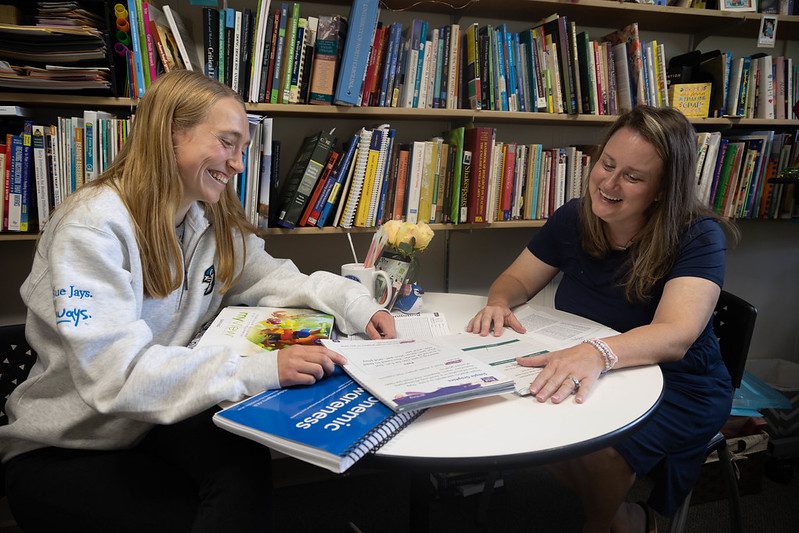
Early Childhood Education and Special Education Dual Major Molly Kleinert ‘26 is analyzing English Language Arts (ELA) curriculum, assessments, and benchmarks across different schools as part of Elizabethtown College’s Summer Creative Arts and Research Program (SCARP).
Working with Associate Professor of Education, PK-12 New Literacies Kathryn Caprino, Kleinert is conducting a content analysis focused on how these curricula align with the Reading Rope, a foundational framework in the “Science of Reading” literacy movement. 
Title of Research
ELA Analysis of Curriculum and Benchmarks Within Different Districts
Student Researcher
Molly Kleinert ’26 (Early Childhood Education and Special Education Dual Major, Early Childhood Education (PreK-4), Special Education (PreK-12))
Faculty Mentor
Dr. Kathryn Caprino, Associate Professor of Education, PK-12 New Literacies
What are you researching?
Kleinert: The purpose of this SCARP project is to give me the opportunity to engage in qualitative research regarding different ELA curriculum, assessments, and benchmarks used at the five different elementary schools. I will do a content analysis on the ELA curriculum, assessments, and benchmarks regarding the Reading Rope. The Reading Rope is a part of the “Science of Reading” literacy approach that schools are using for literacy today. The Reading Rope has two key major strands, which include language comprehension and word recognition, with several components that make up these strands. I will be focusing my research on grades K-4.
Why did you choose this topic?
Kleinert: I selected this topic because I wanted the opportunity to engage in research that allowed me to grow my knowledge in ELA instruction. I was very interested in learning about the variety of different ELA curriculums and benchmarks that school districts in different areas are using. Having the experience and knowledge of how different school districts use a variety of curriculums and assessments will greatly benefit me when I go into the field as an educator.
Additionally, this research allows me to simulate what it would be like for me to be on my future school district’s ELA curriculum team, which each district has. The purpose of this team of teachers is to work together to find the best ELA curriculums and benchmarks for students to engage in. This professional experience I am gaining will help me grow my own knowledge in ELA and literacy areas, which will positively benefit me when I am an educator, and it will encourage me to be an advocate for ELA curriculum and benchmarks that are positively connected to the Reading Rope.
What is the most interesting aspect of this research?
Kleinert: This project has been really interesting because this research is practical to the educational field right now. The current change in ELA curriculum to an explicit and systematic approach is fueling the conversation for school districts to try different ELA curriculums. Seeing the connection that the current curriculums and benchmarks different school districts are using to teach and assess students in regard to the Reading Rope and the new framework for literacy instruction is providing me with valuable information for my research.
This research will help me as an educator advocate for the best literacy programs for my students. Additionally, I have built connections with five different school districts, which allows me to become familiar with different school districts and potentially share this research with them. Having the opportunity to connect with the different school districts has been a great way for me to grow my professional communication skills with these professionals in the field of education.
What are you hoping to accomplish through this research project?
Kleinert: I am hoping to strengthen my ability to use different ELA curriculums so my confidence and ability to teach ELA in the classroom continue to grow. In addition, it is really important to me that through my research, I am able to understand the elements of the Reading Rope through the lens of different curriculums, assessments, and ELA programs to see how it is or is not being used. Lastly, I am hoping to be able to learn about what a content analysis is and then put it into action with the five school districts I am utilizing. While working with the different school districts, I want to be able to build positive connections through email correspondence and meeting in person in a professional manner. My goal is to present my research at the Landmark Conference Summer Symposium in July to share my findings.
Hear from the faculty mentor – Kathryn Caprino
“I am grateful to be doing SCARP this year! Molly is a really motivated student – perhaps one of the most motivated I have ever worked with – so it’s really fun to guide her and see her be excited about her research! SCARP is really wonderful because it gives me an opportunity to dive into qualitative research mode a bit more deeply than I usually get to do in the academic year.
“Working with students who just want to soak up all the learning and are craving to read more and learn more is enriching. Molly’s particular project is so stellar because her work is so timely in the context of the Commonwealth’s structured literacy initiatives, and I’m really excited to learn alongside her this summer!”
