
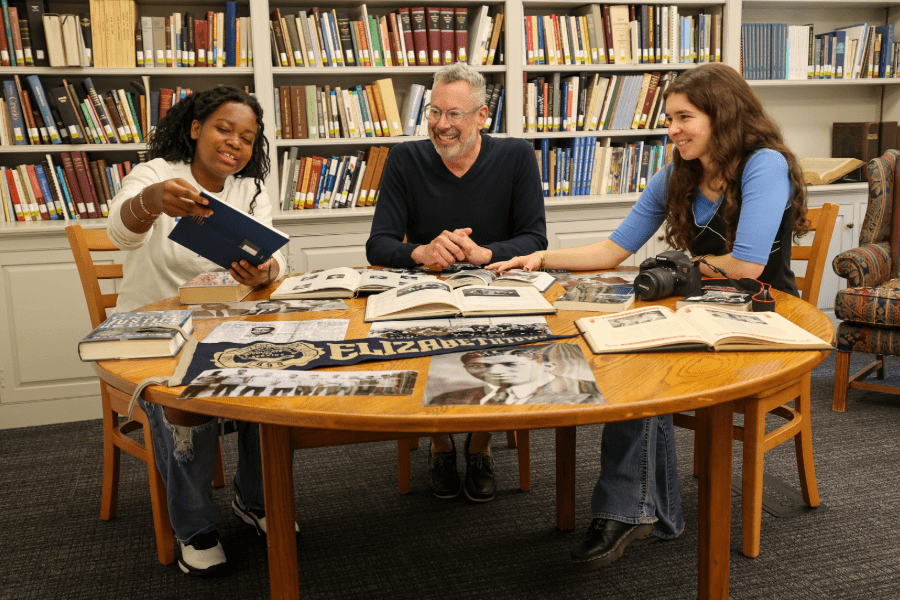
International Business major Mechelle Johnson-Reeves ’28 and Philosophy, Politics, and Economics major Ava Skye Barton ’27 are creating a documentary about one of Etown’s most distinguished alumni, nationally recognized civil rights leader W. Miller Barbour ’32, as part of Elizabethtown College’s Summer Creative Arts and Research Program (SCARP).
Working with Director of Prestigious Scholarships and Public Heritage Studies Jean-Paul Benowitz, the students are combining historical research with visual storytelling to bring Barbour’s legacy to life. Their film will explore his role in early civil rights work and highlight his impact as one of the first Black graduates of the College.
Title of Research
The Prospect for Freedom – The Life & Legacy of Civil Rights Leader W. Miller Barbour (1908-1957) Elizabethtown College Class of 1932 A Documentary
Student Researchers
Mechelle Johnson-Reeves ’28 (International Business)
Ava Skye Barton ’27 (Philosophy, Politics, and Economics)
Faculty Mentor
Jean-Paul Benowitz, Director of Prestigious Scholarships and Public Heritage Studies
What are you researching?
Barton: Professor Benowitz co-authored an article (along with Etown alumni Abigail Sholes ’23 and Eric Schubert ’23) about the life and legacy of W. Miller Barbour (1908-1957): Elizabethtown College Class of 1932, which is currently being reviewed by editors of an academic peer-reviewed journal for publication. Professor Benowitz’s article is serving as the basis for the narration we are creating for a documentary we are making about Barbour. We are reading primary and secondary resources about the Civil Rights movement. We are collecting images from historical societies, archives, and online databases to use in the film. We are developing a plan for how to tell Barbour’s story through audio, photographs, video, and animated means.
Why did you choose this topic?
Johnson-Reeves: In September 2024, Dr. Benowitz, when he was writing an article about Barbour’s life and legacy as a race relations leader, approached me with this project after I shared my long-standing passion for storytelling through film. Over the years, my work has been recognized at local, national, and international film festivals. Though most of my pieces are fiction, the characters I create are deeply rooted in real people—their emotions, struggles, and truths.
This was my first opportunity to move into nonfiction filmmaking, and the subject couldn’t have been more powerful: the story of one of the first Black graduates of Elizabethtown College, a figure who was also a civil rights activist. The project allowed me to merge my artistic skills with my commitment to advocacy and historical truth. I saw this as a way to not only honor an important legacy but to challenge myself creatively and intellectually.
Barton: I have been working as a research assistant and editor for my professor and mentor, Jean-Paul Benowitz was working on the article he wrote about Barbour. In the early days of the Civil Rights Movement, when laws were being passed about desegregation, Barbour introduced a new component to the Civil Rights Movement regarding putting desegregation policy into action through the process of racial integration. Barbour’s contributions to defining the goals of the activism of the Civil Rights Movement are a story largely untold. I chose this topic because I believe Barbour’s story deserves to be known, and having a background in documentary filmmaking, I wanted to be involved.
What is the most interesting aspect of this research?
Johnson-Reeves: What stands out most is how significant Barbour’s accomplishments were—and how little they’re known today. He played a key role in the broader struggle for civil rights. His story isn’t in textbooks, not yet, but his impact is undeniable. That contrast between historical importance and cultural invisibility has fueled my determination to bring his story forward.
Barton: The challenge of determining how to tell a person’s life story.
What are you hoping to accomplish through this research project?
Johnson-Reeves: We are working to create a documentary that educates, uplifts, and inspires. Whether it’s shown locally, shared nationally, or reaches audiences internationally, our goal is to highlight the power of everyday changemakers—people like Barbour, who made a difference without seeking recognition. I hope viewers walk away with a sense of purpose, knowing that real change often comes from those whose stories have gone unheard.
This isn’t just about telling one story. It’s about restoring visibility to voices history has overlooked, and using film as a tool for reflection and social progress. Recognition isn’t the goal—impact is.
Barton: I will end the summer with a deep understanding of the life and legacy of William Barbour and, through this documentary, illustrate what he represented and how his work contributed to the civil rights movement. I aim to hone my skills in visual storytelling and create a documentary film that makes Barbour’s story accessible to the public.
Talk about working with your mentor. How have they helped you throughout this experience?
Johnson-Reeves: Working with Dr. Benowitz has been transformative. As a recent high school graduate, I was struck by how limited my education on civil rights had been, mostly centered on the 1950s and 60s. Through learning from Dr. Benowitz about the history of the Civil Rights movement and working on this project, I’ve come to understand the deeper roots of that movement and the people who shaped it long before mainstream history begins to take notice through educating myself by reading primary and secondary sources as well as the article Dr. Benowitz wrote about Barbour and his role in the Civil Rights Movement.
Our discussions have challenged me to think critically and write with purpose. I’ve also grown as a filmmaker, learning how to distill complex narratives into compelling visuals and tight scripts. Whether this documentary remains a short piece or evolves into something longer, I’m proud of the clarity, truth, and heart we’re bringing to it.
Barton: This will be my second summer working with my mentor, Professor Jean-Paul Benowitz. Interestingly, the research required in this project builds on my work with him last summer. He has continued to challenge me with these projects, making me realize I can do more than I thought and helping me gain confidence in my research abilities. He has provided support and mentorship in the processes of biographical research, and he has given me creative flexibility in the logistics and planning of the documentary.
Hear from the faculty mentor – Jean-Paul Benowitz
“I choose to be involved with SCARP because sometimes our students think engaging in scholarly research will not play a role in their future in business or a profession, and they see guided research and writing as a mostly academic endeavor. Through SCARP, students learn how research is important beyond their college experience. As SCARP students practice the craft of academic research now, they prepare to do research later, in graduate school and in their future professions. The most rewarding aspect of SCARP is when the student’s scholarly research is publicly presented and published. This is when the student realizes that the research they are doing now and the research they will do in the future is important, as it is reviewed, discussed, debated, analyzed, and used by other scholars. The academic research conducted by SCARP students makes a contribution to the scholarship being produced in their academic disciplines.”
