
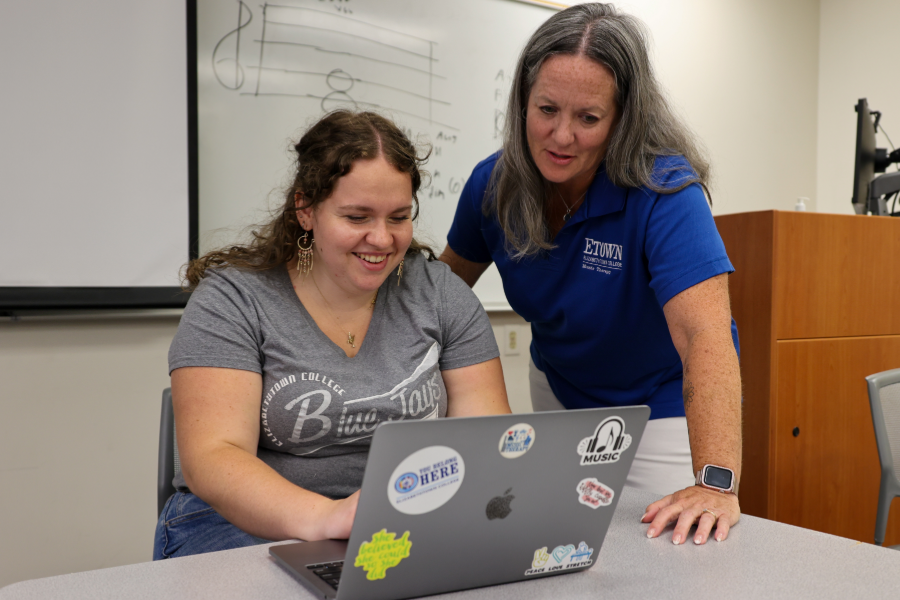
As part of Elizabethtown College’s Summer Creative Arts and Research Program (SCARP), Music Therapy major Marina Tague ’28 is examining middle and high school music programs in rural, low-income school districts in northeast Pennsylvania in pursuit of equitable opportunities for students to expand their musicianship.
Working with faculty mentor and Director of Music Therapy Emily Frantz, Tague is conducting first-hand interviews with local music educators and completing an in-depth literary analysis and presentation presenting her findings. Tague hopes to translate her work into her own nonprofit organization that makes music education readily available to students in rural, low-income school districts in northeast Pennsylvania.
Title of Research
The Benefits of Music-Based Approaches on Belonging and Engagement in Students from Low-Income Households
Student Researcher
Marina Tague ’28 (Music Therapy)
Faculty Mentor
Emily Frantz, Director of Music Therapy
What are you researching?
Tague: This research examines existing music programs for similarities in how they are run and in leadership’s perceptions and observations of students’ belonging and engagement. Throughout this project, I will complete a literary review, interviews with local music educators, as well as a presentation, and a final paper at the conclusion of the project. The hope of this project is to set up background work for a future project to develop a community-based program for students with unequal access to music opportunities.
Why did you choose this topic?
Tague: My high school provided a lot of incredible opportunities to students that other public high schools were not always afforded. Completing a project like this, finding research that supports reasons why music education should be equal access regardless of economic status, or district support, is a very personal topic to me.
What is the most interesting aspect of this research?
Tague: Researching the social development of students after participating in music programs has been especially rewarding. Learning how concepts such as social competency, self-efficacy, empowerment, and peer connection contribute to student growth has strengthened my understanding of the topic and reinforced the importance of equitable access to music education.
What are you hoping to accomplish through this research project?
Tague: I want to be able to advocate for music programs. Ideally, this research could be used to reason as to why student involvement in the arts is so important and those opportunities should be readily available.
Talk about working with your mentor. How have they helped you throughout this experience?
Tague: Professor Frantz has been incredible throughout this entire process. She has been there every step of the way, while still allowing this to be the student-led project it was proposed as. She has been helpful in bouncing ideas off, grounding my ideas when I get a little over ambitious, and supporting my decisions when I’m unsure of the steps to take. It has been so helpful to have a mentor who has been through this process before and understands the steps of having a successful project.
Hear from the faculty mentor- Emily Frantz
It has been my pleasure to support Marina in learning how to begin a research project. She is curious and passionate about expanding opportunities for students in her community through music. I love the collaborative, “community-based” approach that she is taking to interview the stakeholders that are already doing similar work in music in her hometown and surrounding areas. Music therapy research is so important to continue building the clinical evidence needed to demonstrate the science and efficacy. Student research is essential to evidence-based practice and a career based on foundational knowledge that has been collected as our profession continues to evolve. I am so grateful for the SCARP program which provides this amazing opportunity for Etown students.
