
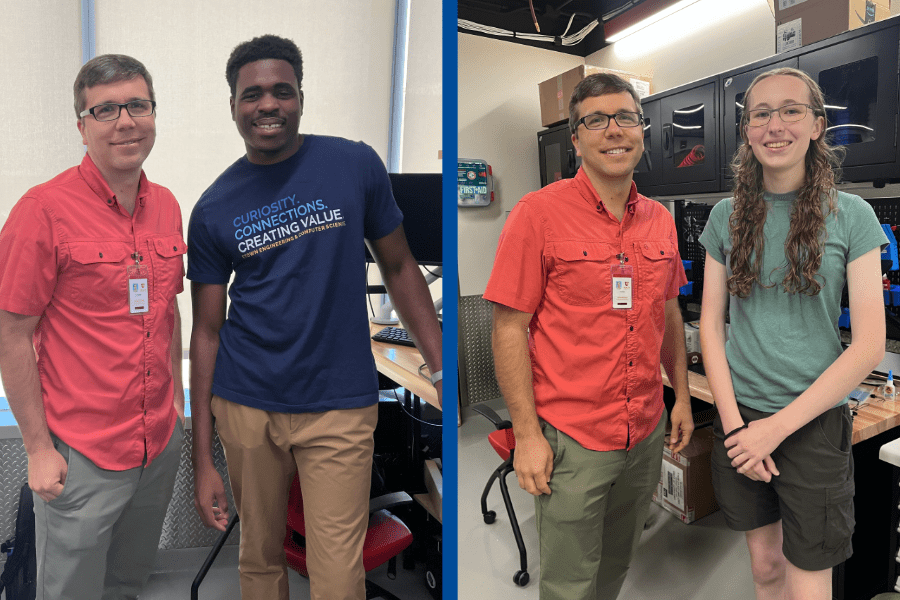
Electrical Engineering majors Emmanuel Attah ’27 and Lilith Wright ’27 are building a small device that sends gentle electrical signals through the skin to create a sense of touch as a part of Elizabethtown College’s Summer Creative Arts and Research Program (SCARP).
Working with Assistant Professor of Engineering Mark Brinton, the students are part of a team doing research at the University of Utah. Attah is focusing on the design and coding of the tiny stimulator, while Wright is helping design a wristband that can safely and effectively send signals to the nerves in the wrist. This study represents the third iteration of a SCARP research dating back to 2023. Their goal is to turn what’s been mostly lab research into real tools that help people, especially those with limb loss, feel more connected to the world around them.
Title of Research
Miniature Electrocutaneous Stimulator Development
Student Researchers
Emmanuel Attah ’27 (Electrical Engineering) and Lilith Wright ’27 (Electrical Engineering)
Faculty Mentor
Mark Brinton, Assistant Professor of Engineering
What are you researching?
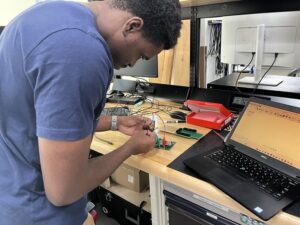
Attah: My research as part of a bigger project is developing and integrating the hardware and firmware for a miniaturized electrocutaneous stimulator circuit. This is a device that delivers electrical signals through skin-mounted electrodes to stimulate nerves and evoke a sense of touch. This research has significant implications for prosthetic development, particularly in assisting individuals with reduced motor function in the hands. It also holds potential applications in virtual and augmented reality systems.
Wright: I am working with my professor with grad and undergrad students at the University of Utah to develop and improve the design of a wristband that is able to stimulate the nerves in the wrist to create sensations in the hand.
Why did you choose this topic?
Attah: After working with Dr. Brinton on a prosthetic hand project, I became deeply intrigued by the application of electrical engineering in the biomedical field. It piqued my interest, especially because this area remains largely unexplored. Additionally, I wanted to gain hands-on experience in electrical engineering by applying engineering concepts to solve real-world problems and develop practical solutions.
Wright: If we’re able to turn this into a usable product, it has the potential to help a lot of people, and I wanted to help do something good. This is also a field that I don’t have a lot of knowledge and experience in, so when Dr. Brinton approached me with this opportunity, I wanted to say yes just so I could learn more about electricity in the human body.
What is the most interesting aspect of this research?
Attah: The most interesting part of my research is taking ideas from concept to practice. After reviewing research literature, running calculations, and doing deep thinking, I’m able to perform digital simulations and real-life tests – bringing the concepts to life. More technically, it’s very interesting to study the variations of skin conditions, how that affects results, and possible ways of measuring the effect so as to design a safe system that works for everyone.
Wright: The fact that this is something basically brand new. Basically, everything related to this whole field of electrical stimulation of the nerves has been purely research, but our project will hopefully be able to move past the research into something usable.
What are you hop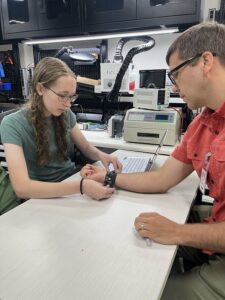 ing to accomplish through this research project?
Attah: My hope for this project is to develop a product or system that significantly improves the quality of life for amputees and individuals who have lost limb sensitivity, while also serving as a stepping stone toward advancing our understanding of the nervous system.
Wright: The biggest issue holding back upper limb prosthetics has been the lack of sensory feedback, but this project is looking for a way to solve that issue. Additionally, we’re hoping that the same technology can be used in VR and AR to create sensory feedback when interacting with a virtual world.
Talk about working with your mentor. How have they helped you throughout this experience?
Attah: Working with Dr. Brinton has been highly collaborative. We engage in frequent idea exchanges, and he consistently challenges me to deepen my understanding. He has been immensely helpful in providing direction, offering clarity, and guiding me toward the right resources.
Wright: Working with Dr. Brinton has been a great experience. I’ve really enjoyed getting to try to be a bit more independent with most of my work and just touching base with him occasionally, but he’s also always been there, willing to help out any time I need it. The idea of going across the country for the summer to do this research project was a bit scary, but being here with Hunter, Emmanuel, Dr. Brinton, and everyone new that I’ve met here has really helped me feel comfortable and confident while doing my work.
Hear from the faculty mentor – Mark Brinton
“Lilith’s work designing and modeling electrodes for noninvasive electroneural stimulation is important because the electrode shape, size, material, and proximity to the neural target all have an impact on whether the desired sense of touch can be achieved. This takes careful and detailed work and modeling.”
“Emmanuel is helping to miniaturize our bench-top stimulator into a much smaller device that could easily be worn on the arm for virtual or augmented reality or be seamlessly integrated into a prosthesis for bionic limbs. Miniaturizing is essential in order to take this technology to market and into the clinic where it can have the largest impact.”
