
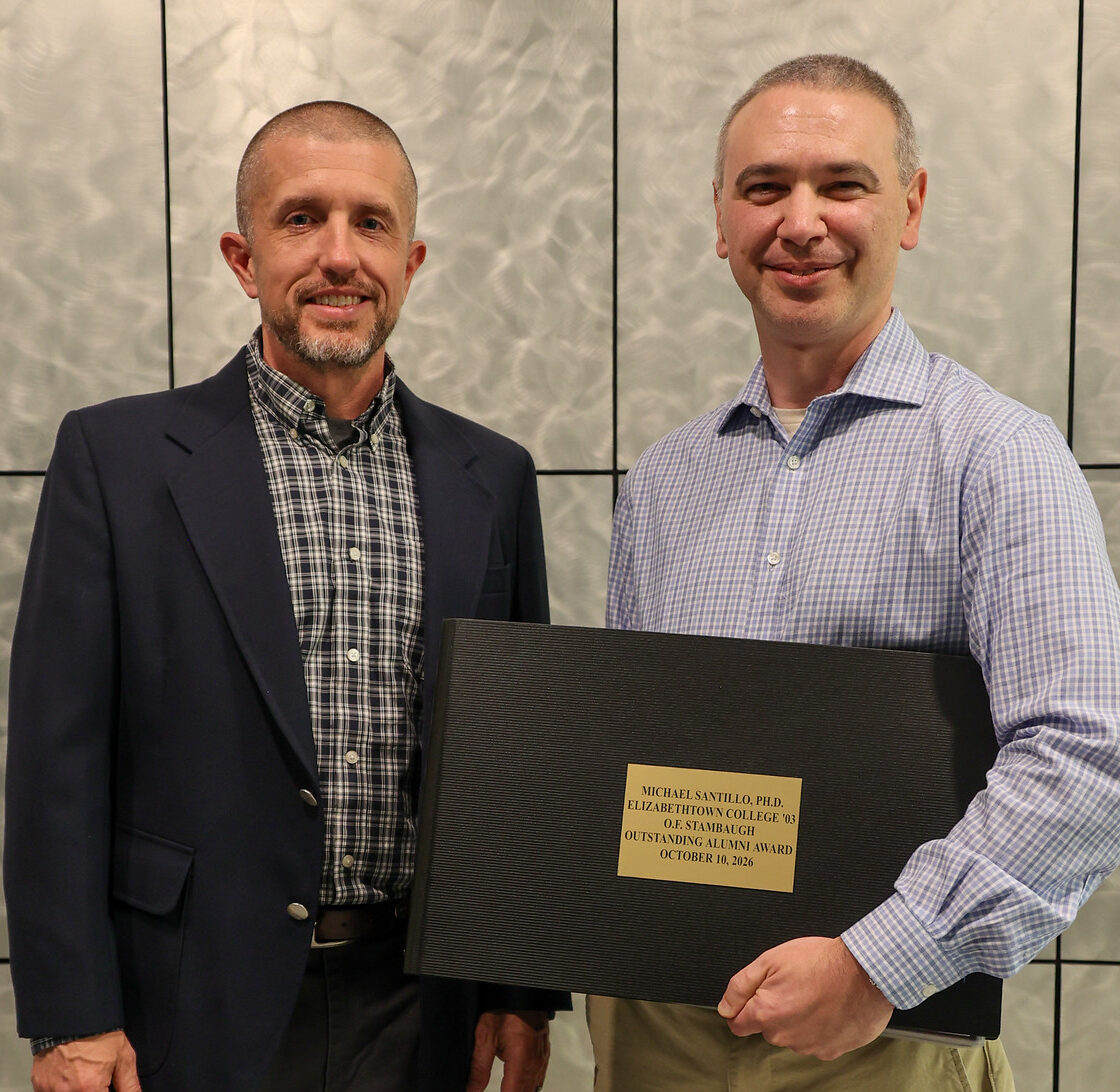
(L-R): Professor of Chemistry and department Chair, Dr. Jeffrey A. Rood, with Michael Santillo ’03, Ph.D.
Elizabethtown College’s Chemistry and Biochemistry Department presented alumnus Michael Santillo ’03, Ph.D., with the Oscar F. Stambaugh Outstanding Alumni Award during Homecoming and Family Weekend on Saturday, October 10.
“Etown was the right place for me,” said Santillo. “I especially valued the department’s close community and faculty who were accessible, supportive, and invested in their students. The hands-on experience I gained through project-based learning, labs, seminars, and peer tutoring gave me a strong foundation for graduate school, and I continue to draw on those skills throughout my career as a research scientist.”
Established in 1974, the Stambaugh Award is presented annually to an Etown graduate who has made notable professional contributions in the fields of chemistry or medicine. The award is named in honor of Professor Oscar F. Stambaugh and his years of service and leadership at the College.
Santillo, who majored in chemistry at Etown, is currently the Acting Chief of the Systems Toxicology Branch in the Human Foods Program at the U.S. Food and Drug Administration (FDA). With more than 16 years of experience at the FDA, Santillo has led the development of experimental and computational alternatives to animal testing for predicting the human health effects of food-related chemicals. He joined the FDA as a postdoctoral fellow, then advanced to Research Chemist and Senior Research Chemist positions before assuming his current role as Acting Branch Chief. Over his career, he has published 30 peer-reviewed articles and book chapters and represented the FDA on national and international toxicology research initiatives. He holds a doctorate in chemistry from Penn State University.
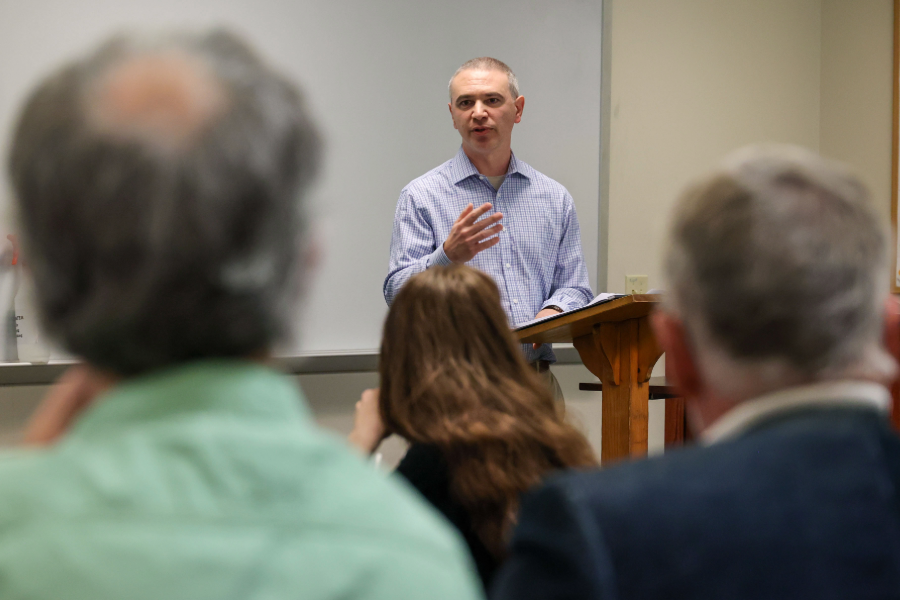
On Friday, Oct. 9, Santillo also delivered a seminar to the Chemistry and Biochemistry Department titled “Beyond Animal Testing: The Evolution of Chemistry-Driven, New Approach Methods (NAMs) for Predictive Toxicology.”
