
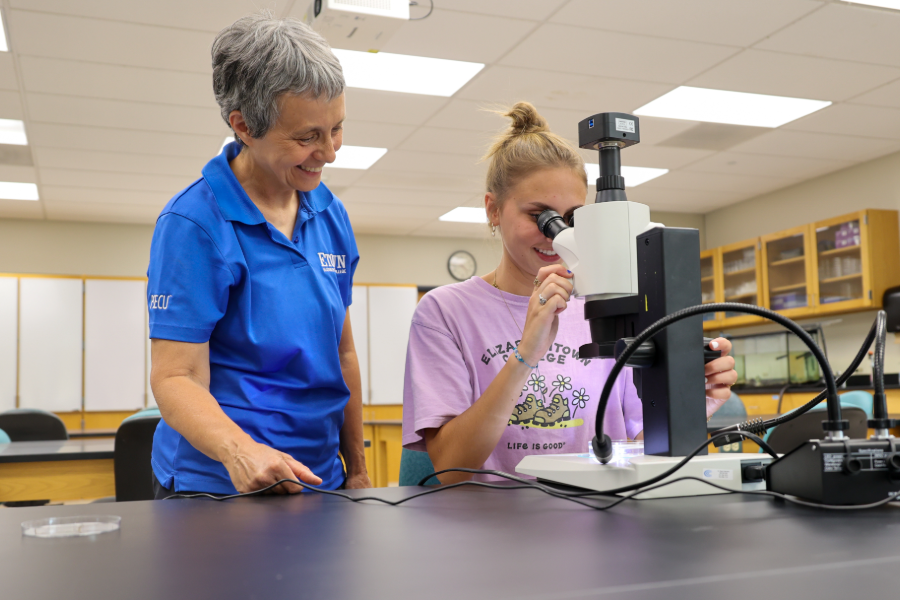
Biology major Kate Wellons ’27 is studying how the microbiome affects an organism’s response to heat stress using the freshwater invertebrate Hydra oligactis as part of Elizabethtown College’s Summer Creative Arts and Research Program (SCARP).
Working alongside Professor of Biology and Co-Chair of the Department of Biological & Environmental Sciences Diane Bridge, Wellons is creating germ-free hydra to compare their response to heat stress with hydra carrying their natural microbiome and hydra with specific bacterial species reintroduced. The research aims to better understand how microbial communities influence an organism’s survival under environmental stress.
Title of Research:
 Effects of the Microbiome on Resistance of the Invertebrate Hydra Oligactis to Heat Stress
Student Researcher
Kate Wellons ’27 (Biology)
Faculty Mentor
Diane Bridge, Professor of Biology and Co-Chair, Department of Biological & Environmental Sciences
What are you researching?
Wellons: The project addresses whether the microbiome of Hydra oligactis affects its response to heat stress. In investigating this, I am working to use a combination of antibiotics to procure germ-free Hydra. Then, I will be testing the Hydra without a microbiome against those with their microbiome, and then Hydra with one isolated bacterial species added back in their responses (mortality rates) to heat stress.
Why did you choose this topic?
Wellons: I chose this project after working closely with past lab members on similar proposals during the past several semesters. I thoroughly enjoyed utilizing the Hydra as a model for other organisms, and focusing on their microbiome is an excellent way to do so.
What is the most interesting aspect of this research?
Wellons: The most interesting aspect of this research is the simplicity and predictability of the Hydra microbiome, enabling it to be an ideal model organism. In other words, Hydra research is convenient to scale onto a much more complex level, without having to take into account the trillions of microbes in the human gut. Analyzing the limited bacterial strains in Hydra is a direct way to test the microbiome without needing to take a deeper dive into every host-microbe interaction found in the human species.
What are you hoping to accomplish through this research project?
Wellons: Through SCARP, I am hoping to gain a solid understanding and increased confidence in faculty-led and independent biological research. I also wish to refine my lab techniques, leading to success in future courses and positions.
Talk about working with your mentor. How have they helped you throughout this experience?
Wellons: Working with Dr. Bridge has been such a treat. She has been a guiding positive light, is passionate about her work with students, and you can immediately tell she loves her hydra! She is responsive and always happy to answer any of my questions that come with independent research.
Hear from the faculty mentor- Dr. Diane Bridge
I really appreciate Kate’s enthusiasm. I’m also impressed by her ability to take initiative. In the lead-up to SCARP, she did a great job arranging to learn techniques from other members of our lab group and getting data from them that related to her project.