
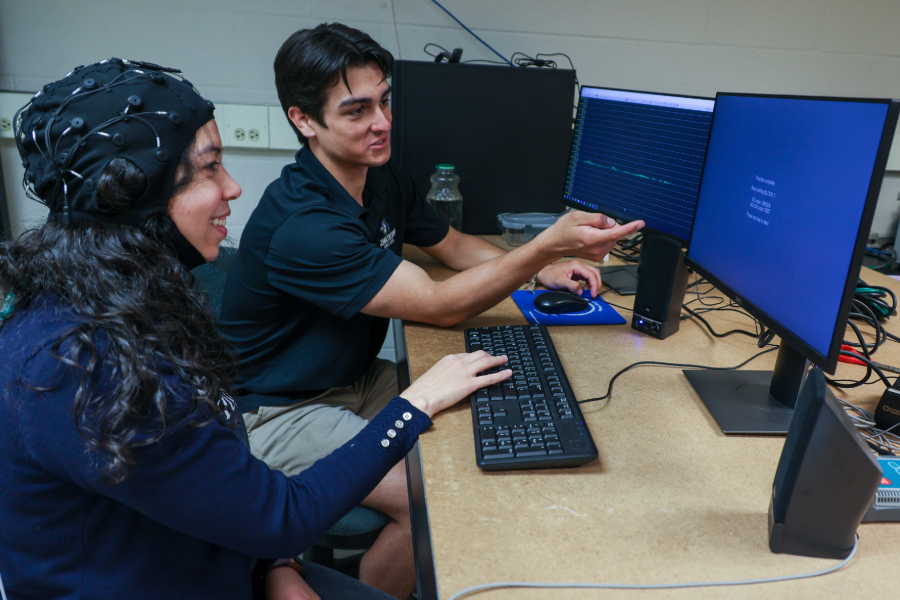
As part of Elizabethtown College’s Summer Creative Arts and Research Program (SCARP), Engineering major Logan Ryan ’27 is working to examine the brain’s inhibitory response to cell phone usage to better understand phone addiction and contribute to broader addiction research.
Faculty mentors Jennifer Wittmeyer and Mark Brinton are assisting Ryan as he uses electroencephalogram (EEG) monitoring technology to study individuals’ responses to cell phones’ frequent auditory stimuli, while also working to determine if reduced screen time eases cell phone addiction. Ryan’s research will lend insight to larger conversations surrounding addiction prevention.
Title of Research
Analyzing Phone Addiction and Inhibitory Control with EEG
Student Researcher
Logan Ryan ’27 (Engineering)
Faculty Mentors
Jennifer Wittmeyer, Assistant Professor of Psychology and Neuroscience Director
Mark Brinton, Assistant Professor of Engineering
 What are you researching?
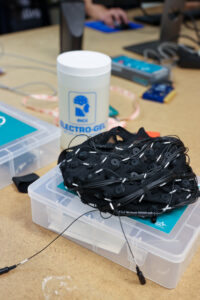
Ryan: I, along with my mentors Dr. Brinton and Dr. Wittmeyer, am investigating the brain’s inhibitory control when it comes to interacting with their cell phone. We are using an EEG to detect these properties and brain activities by collecting brain signals. The brain inhibitory system controls the likelihood of an individual to refrain from engaging in an activity. Therefore, we intend to see how different individuals react to auditory stimuli, such as notification sounds and vibrations, during a cognitive task. We are looking to see what sound produces the least amount of inhibitory control across all the individuals, whether that be sound notifications or vibrations. We are raising the question of whether notification sounds or vibrations are more likely to cause an individual to lose/break focus during a cognitive task. Furthermore, we hope to see if more screen time leads to less inhibitory control as well.
Why did you choose this topic?
Ryan: As a biomedical engineer, I want to use my engineering skills to help those in need. My main area of focus is brain addictions, primarily drug addictions. Addictions, whether that be drugs, phones, food, etc., consume and destroy the lives of many individuals in this world. I hope by identifying the root of these issues, I can develop techniques or equipment that can reverse those effects and improve the quality of life of many individuals. Addiction is never the individual’s fault. The problem lies within the addiction itself and how it interacts with the brain. If we can dial in on what the key causes and solutions are, then the lives of many can be changed for the better.
What is the most interesting aspect of this research?
Ryan: The most interesting aspect of this research is seeing an individual’s brain activity and signals in real time. I am truly blessed to be completing this project with my mentors and grateful to Professor Brinton for allowing me to use this technology to benefit my education and career. I enjoy working in the lab and interacting with complex equipment such as the EEG.
What are you hoping to accomplish through this research project?
Ryan: I am hoping to gain a better understanding of phone addictions and how to better combat high screen times. Phones have become increasingly addictive over the past decade and almost everyone has access to the internet and social media. Notifications play a key role in keeping users hooked on their phone and waiting for the next thing, whether that be a text message, news alert, etc. Whatever the case may be, notifications have the ability to grasp our attention. Thus, I want to compare the properties of notification sounds versus vibrations to see what elicits a greater inhibitory control response.
Talk about working with your mentor. How have they helped you throughout this experience?
Ryan: My mentors Dr. Brinton and Dr. Wittmeyer, have both helped me tremendously throughout this experience.
Dr. Brinton has guided me through a lot of the project, especially the data collection and filtering part of the project. With a background in bio-electrics and prior experience with MATLAB and EEG software, he has helped me develop an experiment involving these software programs that target my proposed question. I have been able to effectively integrate these software programs and direct them to interact with one another to collect and analyze data.
Dr. Wittmeyer has helped me a lot on the psychology front of the experience. She also has previous experience utilizing EEGs and similar software programs to complete research opportunities. She has helped me troubleshoot the experiment multiple times and has given me great advice when needed. She has helped me define the parameters of this experiment and truly understand what it takes to design and execute an experiment.
Combining Dr. Wittmeyer’s psychology knowledge with Dr. Brinton’s engineering background has benefited my project, and I appreciate them both. I thank them for all their hard work, time, and effort that they have both devoted to this project.
Hear from the faculty mentor- Dr. Jennifer Wittmeyer
Working with Logan has been a wonderful experience. One of his greatest strengths is his ability to teach himself new skills. Because this project involves some EEG methods that were new to all of us, Logan had to do a tremendous amount of independent learning through tutorials, documentation, and troubleshooting. He took ownership of that process and became the driving force behind many of the technical aspects of the project. He’s also incredibly curious, respectful, hardworking, and competent. When he encounters a challenge, his first instinct is to learn more and figure out a solution. He provides a level of initiative and independence that I would normally expect from a graduate student. To say I’m impressed with his dedication and skills would be an understatement.
