
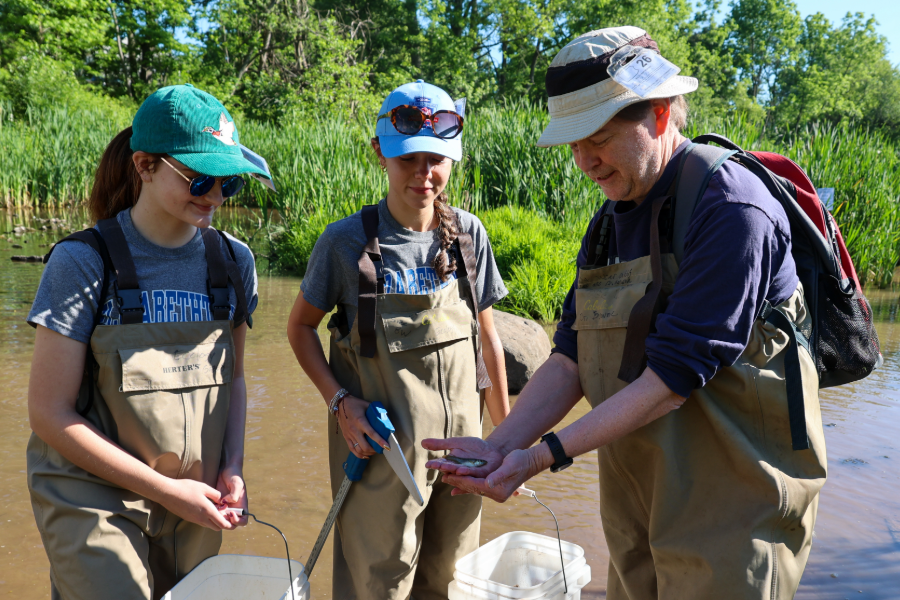
Elizabethtown College students Lilianna DeBlasio ’27 and Hannah Walker ’28 are conducting research at several local restored wetlands to observe the different turtle species that inhabit them as part of Etown’s Summer Creative Arts and Research Program.
Under the guidance of Professor of Biology David Bowne, DeBlasio and Walker are examining the ecological benefits of restored wetlands while surveying the local flora and fauna that inhabit them.
Title of Research
Turtle Population Dynamics in Restored Floodplain Wetlands
Student Researchers
Lilianna DeBlasio ’27 (Environmental Science)
Hannah Walker ’28 (Biology, Pre-Health)
Faculty Mentor
Dr. David Bowne, Professor of Biology
 What are you researching?
DeBlasio: Floodplain restoration uses a variety of techniques to improve and manage water systems, often resulting in the creation of “new” ecosystems. One common approach is legacy sediment removal, which facilitates floodplain reconnection. The Hickory Lane Stream and Floodplain Restoration Project was completed along Conoy Creek in Elizabethtown Borough to meet stormwater management requirements. This raises the question of how biodiversity responds following restoration.
The “Field of Dreams” hypothesis suggests that restoring ideal biological conditions will ultimately lead to ecosystem recovery. Our study explores a potential limitation of this hypothesis by examining whether poor connectivity between restored habitats and existing wetlands may inhibit the movement and colonization of wetland species. We focused specifically on the spotted turtle (Clemmys guttata), a Pennsylvania state-vulnerable semi-aquatic freshwater turtle. Following one full growing season, we conducted biological surveys at the restoration site. Turtle trapping was carried out using 20 baited minnow traps placed throughout the stream channels, and vegetation surveys were also completed.
In addition, we mapped the structural connectivity of the landscape within a 2-km radius of the restoration site using ArcGIS Pro to assess the hypothesized permeability of the surrounding landscape. The biological surveys indicated that wetland habitat had become established; however, turtle trapping yielded only snapping turtles and red-eared sliders. ArcGIS analysis also revealed that much of the surrounding landscape consists of developed land, which may serve as a barrier to colonization. Continued monitoring of the restoration site and surrounding habitats is needed to better understand the potential for future species colonization.
Walker: Our research will focus on surveying turtles at multiple restored wetlands. After restoration, we are determining if different turtle species are able to move to and inhabit these wetlands. We will put traps throughout the sites and observe what species of turtles we find.
Why did you choose this topic?
DeBlasio: The concept of surveying the site’s biological conditions was introduced by my professor, who has conducted similar research at sites throughout the region. I chose to focus my independent project on structural connectivity after taking a course in Geographic Information Systems (GIS), knowing I could apply my new knowledge to support the biological surveys.
Walker: This topic was chosen by our professor, Dr. Bowne, as he has a professional history of researching turtles. While this research is a great opportunity to learn about the various turtle species, it also highlights the importance of restored wetlands. Wetlands are inhabited by a wide variety of flora and fauna and can help increase biodiversity in our area. By studying the turtle populations in these wetlands over time, we can provide evidence of the benefits wetlands provide to an ecosystem.
What is the most interesting aspect of this research?
DeBlasio: The most interesting part of this research is analyzing the landscape surrounding the restoration site using ArcGIS Pro. By digitizing the area with land use and parcel maps and assigning hypothesized permeability values to different land uses, I was able to identify potential explanations for the biological survey results.
Walker: The most interesting aspect of this research is the unpredictability that comes with setting up traps in a wetland. While we can try to guess what species we will catch, there is no way of knowing what turtle species we will find, in addition to any other animals inhabiting the sites. It is exciting not knowing what we will see!
What are you hoping to accomplish through this research project?
DeBlasio: I am hoping to gain hands-on experience with both fieldwork and independent research. The biological surveys are being conducted through setting baited minnow traps and vegetation surveys, both processes serving as important fieldwork experiences for my professional career. I hope to also gain experience with developing my research skills and combining all of these experiences in a poster presentation.
Walker: I am hoping to get a general sense of the population sizes of turtle species in the restored wetlands. Since the sites we will be at have been restored only in the last few years, they have not had many growing seasons. I am intrigued to see what can be supported in the wetlands after such little time. As a student on a Pre-Vet track, I also hope to learn a lot more about individual species in more detail.
Talk about working with your mentor. How have they helped you throughout this experience?
DeBlasio: My mentor, Dr. Bowne, has been one of the most impactful figures in my college career. He is impressively passionate about the field of ecology and takes a special interest in educating others. My time working with him has been very meaningful and has provided me with several skills I foresee myself using later in life. He has provided very important guidance throughout this experience while also encouraging my partner and me to take ownership of our independent projects.
Walker: Working with Dr. Bowne has been a great experience. He has pushed us to learn as much as possible during our time at SCARP, including topics outside of turtle populations. He has encouraged my partner and me to develop independent projects related to our main project, but with the freedom of picking a topic of our choice. I appreciate being challenged and Dr. Bowne’s willingness to support our individual interests!
Hear from the faculty mentor- David Bowne
“Working with Hannah and Lily has been fantastic. Both are energetic, enthusiastic, and ready to roll with the unexpected turns of field research. It is easy to romanticize ecological research as just being outside playing with turtles without realizing the physical and mental demands of the work. Both Lily and Hannah have demonstrated field hardiness. They are both curious about the restored wetland beyond our primary focus on its use by turtles. Lily has shown a strong interest in learning the identification skills of the many plants in this ecosystem, many of which only grow in wetlands. Hannah has been learning bird identification and how to read the landscape by what plants are growing where. Curiosity is a great attribute for scientists, and both are proving curious every day.”
