
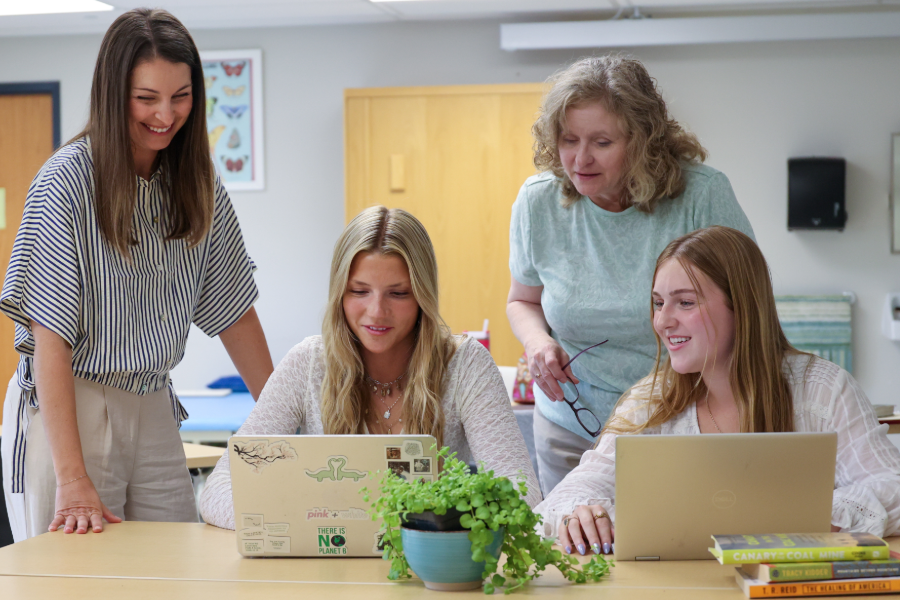
Elizabethtown College Occupational Therapy students Kate Bendall ’27 and Riley Hennelly ’27 are evaluating the impact of content-specific book clubs on aspiring healthcare professionals’ understanding of global health care systems as part of Etown’s Summer Creative Arts and Research Program.
Their project derives from a healthcare course, HE210 Global Health Care Systems, taught by faculty mentors, Associate Professor of Public Health and Assistant Professor of Occupational Therapy, Marla Davis, and Associate Professor of Public Health and Program Director for the B.S./M.S. Program Dr. Deborah Waltermire-Burton, where students took part in book clubs centered on the varying degrees of worldwide healthcare. Bendall and Hennelly are examining students’ reception of the project to determine the viability of using similar pedagogical methods in other OT and healthcare-related programs.
Title of Research
Using Student-Led Book Clubs to Facilitate Socio-Cultural Awareness and the Impact on Healthcare
Student Researchers
Kate Bendall ’27 and Riley Hennelly ’27
Faculty Mentors
Marla Davis, Assistant Professor of Occupational Therapy
Dr. Deborah Waltermire-Burton, Associate Professor of Public Health and Program Director for the B.S./M.S. Program.
 What are you researching?
Hennelly: In our research, we are examining the impact content-specific book clubs can have on student learning. We are evaluating if these book clubs are an efficient learning tool for teaching OT students about the social, cultural, and political influences on the healthcare systems.
Why did you choose this topic?
Bendall: Our faculty mentors created and taught the occupational therapy class that the book clubs originated from. A major portion of this class entailed reading a book about a healthcare system and reflecting on what was learned. They created this research project to gain better insight on how students were able to learn about healthcare systems from the book club assignment.
Hennelly: Dr. Waltermire-Burton and Dr. Davis created and taught the 200-level OT class global health care systems, from which this project is derived. The goal of this class is to not only teach students what healthcare looks like around the world but also give them a deep understanding of the implications of the different facets of healthcare and how it will apply to and affect them as future healthcare professionals. The method of using a personal account and narrative teaching style through book clubs in this class has shown a positive student learning outcome. Our research evaluates the true growth and biggest areas of reflection in student learning to see the full impact of these book clubs.
What is the most interesting aspect of this research?
Bendall: The most interesting part of this research is being able to evaluate what students were able to take away from the book club assignment. As future healthcare providers, it is crucial that students learn about the varying quality and accessibility of healthcare. This research addresses the important question of what methods are effective in doing that in a very interesting way. I also have family from various countries who have experienced multiple healthcare systems, which increases my interest in this research topic as well.
Hennelly: The most interesting aspect of this research is being able to evaluate the impact on students’ healthcare knowledge. In my past three years at Etown, this book club project was one of the most impactful learning strategies I have come across in terms of my true understanding of material, retention, holistic medical perspectives, etc. It has now come full circle, and I get the opportunity to analyze how students are learning through their reflections from this book club. I evaluate the lived experiences they read about to see if and how it resonated with them, gave them perspective, and prepared them for their future as occupational therapists.
What are you hoping to accomplish through this research project?
Bendall: I would like to cultivate and contribute high quality research on the use of book clubs in occupational therapy education. I am hoping that the results of our research project will benefit the future of OT education by addressing what the use of book clubs can bring to the educational environment and how students could benefit from this teaching method.
Hennelly: Through this research I hope to add to the current literature involving medical education techniques. In our work, I hope that the conclusions and impacts we discover can shed some light on the impacts a book club can have on aspiring healthcare professionals. With our research, a goal is to help inform OT and medical-related programs of the possible merits a book club holds in their educational regime.
Talk about working with your mentor. How have they helped you throughout this experience?
Bendall: Our mentors are the reason we are able to be a part of this opportunity in the first place. They created this research project with so much thought and detail and have guided us on how to contribute to the best of our abilities. Their consistent support and guidance has allowed us to put forth the best research and work we can produce.
Hennelly: Our mentors have been such an integral part of our success thus far in this research. They are the reason we are able to be a part of an amazing research opportunity like this, having created the class our project is derived from and cultivated the premise of our research. They have offered excellent insights to us on the strategies and potential our research could yield. Additionally, they are a delight to work with and motivate us to be the best possible version of aspiring OTs we can be.
Hear from the faculty mentors- Dr. Marla Davis and Dr. Deborah Watermire-Burton
Davis: At Etown and within the Occupational Therapy Department, we are intentional about connecting with our students, whether that be during our advising sessions, in the classroom, or in a quick conversation in the hallway. For me, the most rewarding part of this program is that it provides another opportunity to connect with students on a more individualized level. It is also really exciting to see their identities as student researchers grow and develop as they hone their skills.
Waltermire-Burton: This is our first time working on a SCARP project. We think the SCARP program allows us to work with students on a closer level and gives students an opportunity to develop their own skills in research techniques. The timing of the summer schedule also means that students can focus on this without the typical pressures of a full course load of classes and other assignments. While both Marla and I have summer responsibilities, our summer pace is also different from the typical academic year and allows us additional time to engage in this type of project.
