
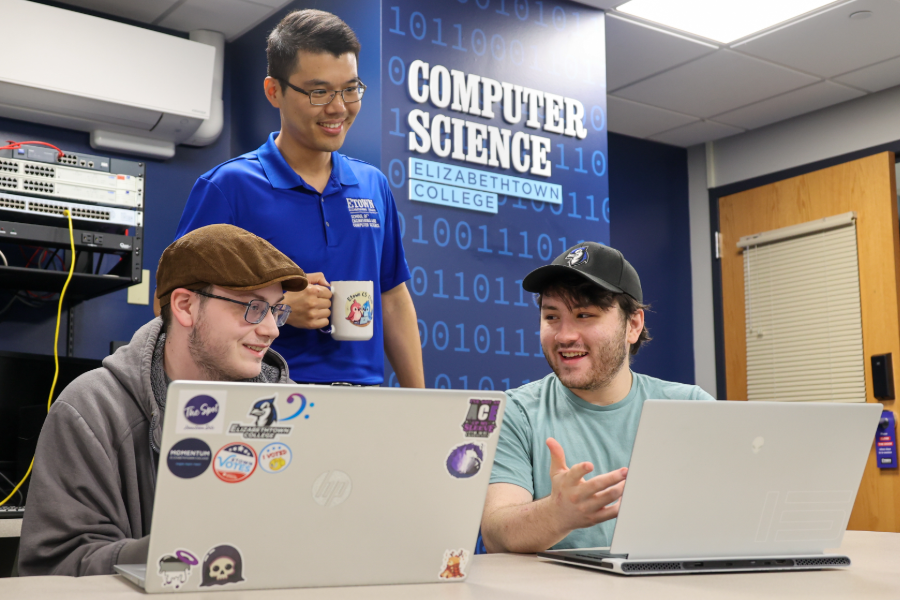
Elizabethtown College Computer Science majors Alex Pellet ’27 and Wyatt Wilfong ’29 are taking a privacy-first-approach to using AI technology to create a generative system that predicts student success outcomes as part of Etown’s Summer Creative Arts and Research Program.
Working alongside Associate Professor of Computer Science Peilong Li, the two Blue Jays are using advanced technological frameworks to help predict student success outcomes while safeguarding student anonymity and ensuring compliance with Family Educational Rights and Privacy Act (FERPA) guidelines.
Title of Research
JayQuery: Privacy-Preserving Student Success Prediction with Federated Learning
Student Researchers
Alex Pellet ’27 (Computer Science) and Wyatt Wilfong ’29 (Computer Science)
Faculty Mentor
Peilong Li, Associate Professor of Computer Science
What are you researching?
Pellet: JayQuery is a privacy-first approach to machine learning, focused on predicting student success while preserving the confidentiality and anonymity of student data throughout the model development process. The project is designed to ensure compliance with ethical data-handling practices and FERPA privacy requirements by minimizing the exposure of sensitive educational records.
To achieve this, JayQuery implements a Vertical Federated Learning (VFL) architecture, enabling multiple clients to collaboratively train a model without directly sharing their datasets. The predictive model is built using a Split Neural Network (SplitNN) approach, which distributes computation across clients and further reduces the risk of data leakage. In addition, Differential Privacy (DP) techniques are incorporated to prevent student information leaking from the model.
Why did you choose this topic?
Pellet: This topic was chosen by the mentor for this project, but I agreed to participate in the project as I was interested in learning more about advanced machine learning topics and how they are being implemented in the industry. The chance to learn about these new architectures and practice privacy conscious data science was exciting for me.
Wilfong: This topic was chosen by our faculty mentor, and I decided to participate to gain more experience.
What is the most interesting aspect of this research?
Pellet: The most interesting aspect of this project is its potential to improve student success predictions while not compromising on privacy. The research explores an emerging technological approach that enables institutions to gain valuable insights while protecting sensitive student information.
Wilfong: This is a great opportunity to explore a new subject without the financial, professional, or time commitments that often come with pursuing an unfamiliar interest.
What are you hoping to accomplish through this research project?
Pellet: I am hoping to have a finished product that I can be proud to present to others, and hopefully have it evolve into something schools would actually use. I think the knowledge that I will learn during this time will also help me immensely as I look to graduate and continue my career in similar fields.
Wilfong: I am hoping to get a solid understanding of cybersecurity, even if I do not plan on it being my career.
Talk about working with your mentor. How have they helped you throughout this experience?
Pellet: My mentor has been very helpful in this process. He has taken a very hands-off approach day-to-day but makes sure to keep us on track with weekly check-ins and goal alignment. If I have any question I need answered, I can be assured that he will have some way to assist me in whatever problem I am facing. I have appreciated this style, as it allows me to learn on my own and complete tasks in my own way, while also not feeling totally stranded without any direction or assistance.
Wilfong: The project expectations are organized and clearly defined, which I find very useful as I do not know what I would be doing without the guidance we have been provided.
Hear from the faculty mentor – Dr. Peilong Li
“The classroom can only take students so far. You can teach someone the theory of machine learning or cryptography, but there’s a completely different kind of learning that happens when a student is staring at a real problem with no textbook answer in sight. What I find most rewarding about SCARP is watching that transformation happen in real time. One of my students on this project is a first-year student who, just weeks ago, had never done anything with cryptography. By the end of the summer, he’ll have built a working privacy protocol from scratch. That’s not something you can put a grade on–that’s a student discovering what they’re actually capable of. That moment is why I do this.”
