
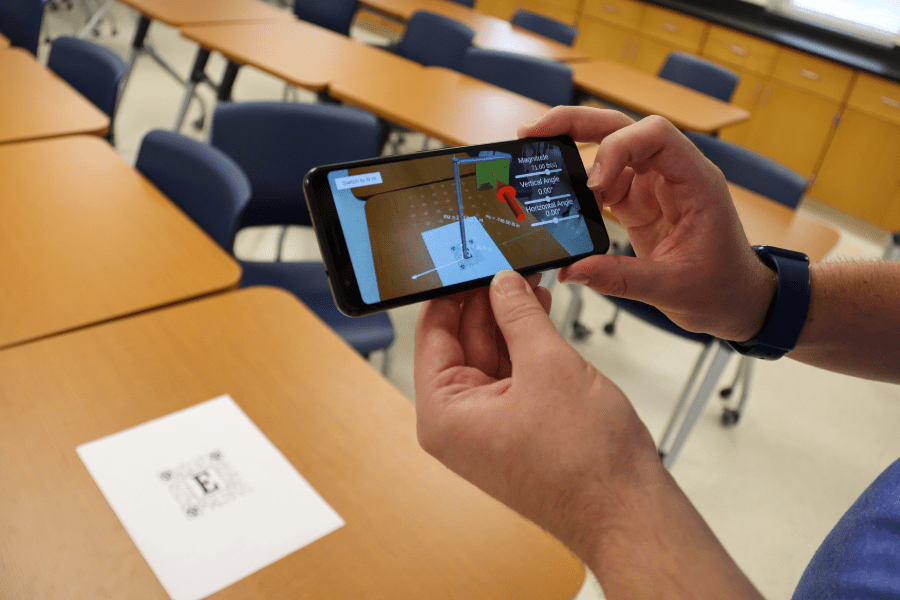
Through the use of cutting-edge Augmented Reality (AR) software, Computer Engineering major Leif Hoffman ’26 is working alongside faculty mentor and Associate Professor of Engineering & Physics, Jean Batista Abreu as part of the Summer Creative Arts and Research Program (SCARP) to develop an application that will allow Elizabethtown College students to better visualize concepts they are learning in entry-level Engineering courses.
Their work aims to make problem-solving exercises more authentic and relevant for students while creating a repository of learning resources that move away from unrelatable textbook problems to provide interactive, realistic structures and machines to study.
Title of Research
Augmented Reality Tool for Engineering Analysis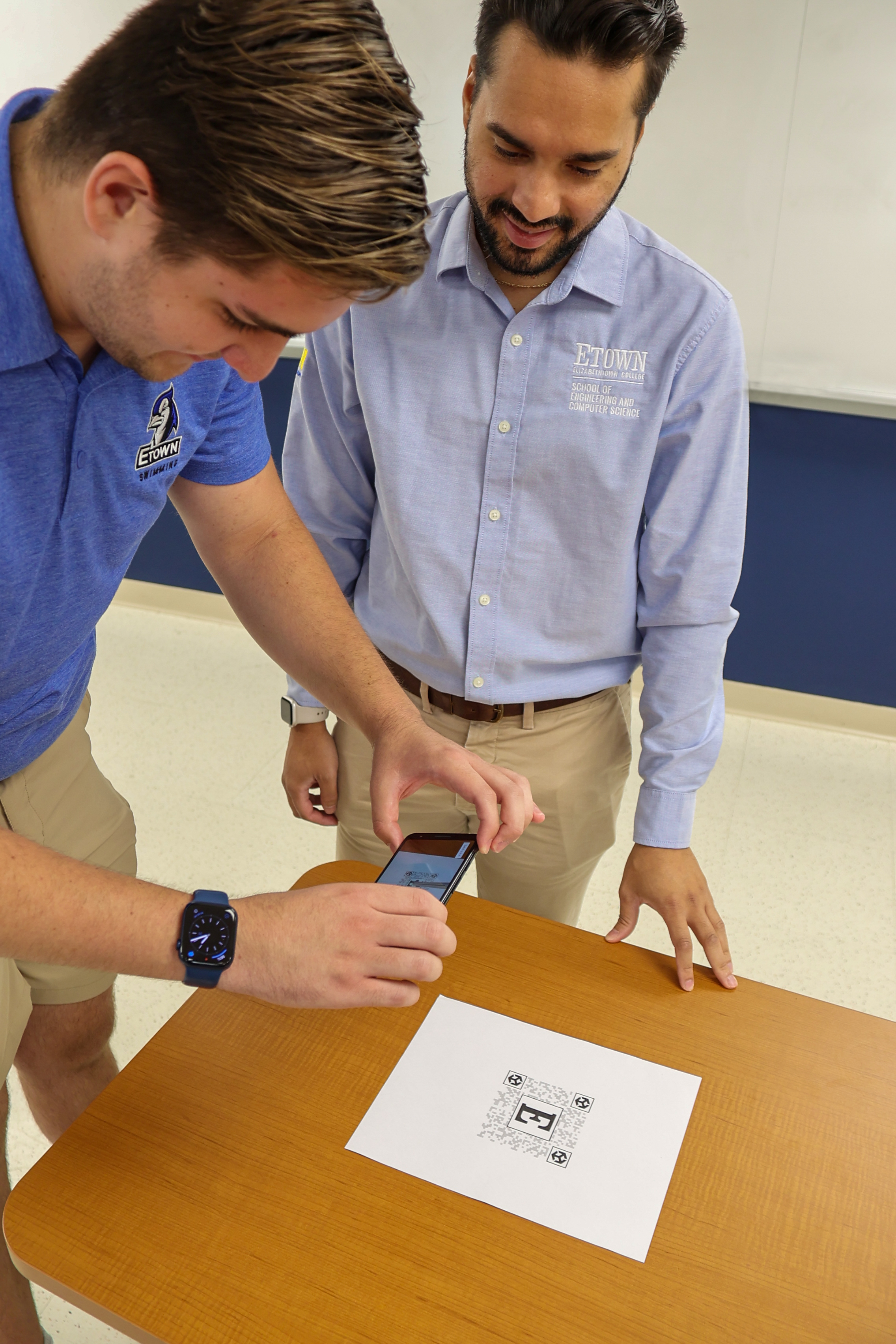
Student Researcher
Leif Hoffman ’26 (Computer Engineering major)
Faculty Mentor
Jean Batista Abreu, Associate Professor of Engineering and Physics
What are you researching?
Statics (an introductory Engineering course at Etown) is one of the first steps to learning mechanics and is challenging for new students who struggle with visualization. The AR application is designed to help students understand the early concepts found in statics by creating a 3D visualization of a signpost and the moments it has from a given force.
Why did you choose this topic?
The initial idea of the project was suggested by my mentor for the project. After talking about the idea for a while and figuring out what exactly the project was going to be, I really picked up a lot of interest because it allowed me to not only gain new skills in programming but to also get experience in general engineering and know what work in my field could be like.
What is the most interesting aspect of this research?
I believe the most interesting aspect that I came across was how I was applying skills from more than just my major’s background. Statics is not the first thing I think of when I hear computer engineering, but it really opened me to the concept of engineers from different concentrations working together. In this case, it was a computer engineer (me) and a civil engineer (my mentor).
What are you hoping to accomplish through this research project?
By the end of the project, I am hoping to gain skills within programming, as well as learning how to use Unity. Finishing the product and having it available for people to use is in mind, but gaining other skills throughout the project is my main goal. The hard skills, such as programming in C# and being proficient in Unity, are helpful to my field, but so are the soft skills like being able to communicate effectively to other people and audiences about my work.
Talk about working with your mentor. How have they helped you throughout this experience?
Dr. Batista has been a great mentor throughout my SCARP project. This is my first time doing SCARP, and he has been great at guiding me through everything SCARP offers and has helped me plan for each step through the project. Moreover, he has been my second set of eyes on the project, allowing me to get another perspective on my work and know where to direct it next. He has been a wonderful advisor throughout the project, and I am thankful for his help on my first time through SCARP.
Hear from the faculty mentor — Jean Batista Abreu